
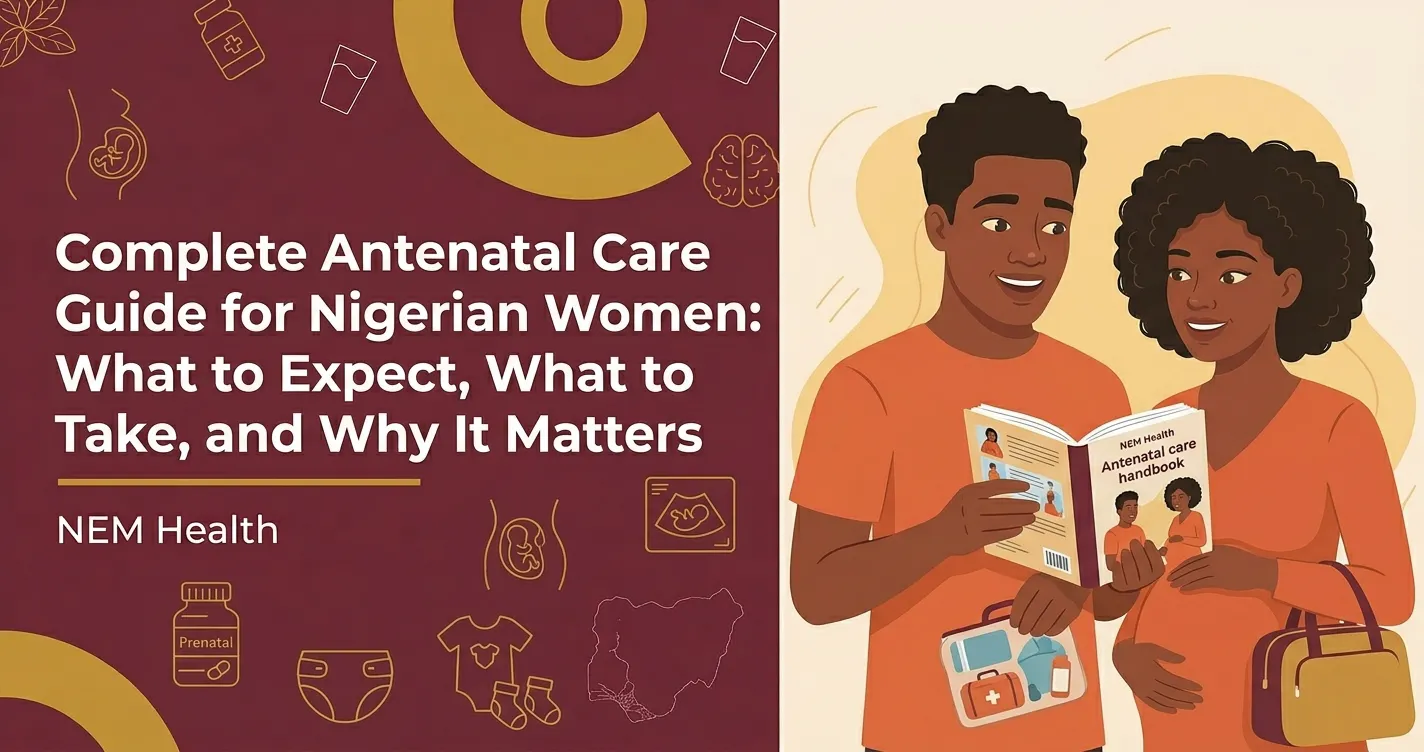
Complete Antenatal Care Guide for Nigerian Women: What to Expect, What to Take, and Why It Matters
NEM Health
April 9, 2026
Finding out you are pregnant is one of the biggest moments of your life. And almost immediately, the questions start. When do I start antenatal visits? What drugs will they give me? How many times do I need to go? What is my doctor actually checking for?
If you have been searching for a clear, honest guide to antenatal care in Nigeria, you are in the right place. This article breaks down everything you need to know, from your very first visit to delivery, in simple language that actually makes sense.
Here at NEM Health, we believe that a well-informed mother is a healthier mother. And a healthier mother means a healthier baby. We dey for you, from the first trimester to the last.
What Is Antenatal Care and Why Does It Matter?
Antenatal care, commonly called ANC, is the healthcare you receive from a doctor, midwife, or nurse while you are pregnant. It covers regular checkups, tests, vaccinations, and the medications and supplements your body needs to carry a healthy pregnancy to term.
It is not just about the baby. Antenatal care protects you too. It monitors your blood pressure, checks for complications like pre-eclampsia and anaemia, and gives your healthcare provider the chance to catch problems early before they become dangerous.
The World Health Organisation recommends a minimum of eight antenatal care contacts throughout pregnancy. However, data from the 2018 Nigeria Demographic and Health Survey shows that only about 20% of Nigerian women make it to eight or more visits, with the number dropping significantly in rural areas. (Source: medRxiv, Adewuyi et al., 2024)
The good news is that awareness is growing. And with the right information and the right health plan, there is no reason why you cannot give yourself and your baby the full benefit of proper antenatal care.
When Should You Start Antenatal Care?
As soon as you confirm your pregnancy. Ideally, your first antenatal visit should happen before 12 weeks, which is the end of your first trimester. The earlier you start, the better. Some of the most important interventions, like starting folic acid, happen even before you fall pregnant or in those very early weeks.
Many Nigerian women wait until their second trimester to start ANC, sometimes because of cultural beliefs, fear of early announcement, or lack of access to healthcare. But early booking gives your doctor a full picture of your health and creates a baseline they can use to monitor you throughout the pregnancy.
How Many Antenatal Visits Do You Need?
The WHO recommends at least eight contacts, spread across your pregnancy like this:
- First trimester (weeks 1 to 12): One visit, ideally before week 12
- Second trimester (weeks 13 to 27): Two visits, at approximately 20 weeks and 26 weeks
- Third trimester (weeks 28 to 40): Five or more visits, becoming more frequent as your due date approaches
After 24 weeks, visits become more frequent because your baby is growing quickly and your body is under more strain. Your healthcare provider will want to monitor your blood pressure, the baby's position and heartbeat, and watch for signs of early labour or complications.
What Actually Happens at an Antenatal Visit?
Every visit will typically include some or all of the following:
- Blood pressure check
- Weight measurement to track healthy weight gain
- Urine test to check for infections and protein levels
- Blood tests (checking for anaemia, HIV, syphilis, blood group, and genotype)
- Listening to the baby's heartbeat
- Measuring your bump to track the baby's growth
- Ultrasound scans at key stages
- Tetanus vaccination
- Prescription and review of routine antenatal drugs
Your healthcare provider will also use these visits to counsel you on nutrition, exercise, danger signs to watch out for, and your birth plan. Never leave a visit without asking the questions on your mind. No question is too small when it comes to your pregnancy.
Routine Antenatal Drugs and Supplements in Nigeria
This is one of the most searched topics around antenatal care, and for good reason. Many women are unsure what they are taking, why they are taking it, and whether it is safe for their baby. Here is a clear breakdown of the standard drugs and supplements prescribed at antenatal clinics across Nigeria.
Important note: Always take drugs exactly as prescribed by your doctor. Do not take any medication or supplement during pregnancy without professional guidance, even if it seems harmless.
1. Folic Acid
Folic acid is arguably the most important supplement in pregnancy, especially in the first trimester. It is a B vitamin that supports the development of your baby's brain, spine, and nervous system. Getting enough folic acid in the early weeks significantly reduces the risk of serious neural tube defects like spina bifida.
The CDC recommends at least 400 mcg of folic acid daily for women of childbearing age, rising to at least 600 mcg during pregnancy. Ideally, you should start taking it before you conceive. (Source: Centres for Disease Control and Prevention, CDC)
You can also boost your folate intake naturally through dark leafy vegetables like pumpkin leaves and ugu, oranges, bananas, and fortified cereals.
Also read: What Causes High Blood Pressure in Young Adults?
2. Iron Supplements
Iron deficiency anaemia is extremely common in Nigerian pregnant women. When you are pregnant, your body needs almost twice its usual amount of iron to produce extra blood for the baby. Yet research suggests that roughly 50% of pregnant women do not get enough iron. (Source: NimedHealth, citing WHO data)
Low iron levels can cause fatigue, dizziness, and breathlessness in the mother, and increase the risk of low birth weight and premature delivery for the baby. Your antenatal clinic will prescribe iron tablets as part of your routine medications, and the WHO recommends iron supplementation throughout pregnancy. (Source: WHO, Prenatal Care Guidelines)
Boost your iron intake through food, too. Eat more red meat, beans, dark leafy vegetables, and liver in moderate amounts. Taking your iron tablet with a glass of orange juice helps your body absorb it better.
3. Vitamin B Complex
B vitamins support your energy levels, your nervous system, and your baby's development. Vitamin B12 in particular is essential for the development of the baby's brain and spinal cord, while B6 helps manage the nausea that many women experience in early pregnancy.
Research shows that a study at Enugu State Teaching Hospital found that iron, folic acid, and vitamin B complex were among the core routine medications prescribed throughout antenatal care. (Source: PMC, European Journal of Midwifery, 2020)
4. Vitamin C
Vitamin C helps your immune system stay strong during pregnancy when it is naturally more susceptible to infections. It also supports the development of your baby's bones, teeth, and skin, and crucially helps your body absorb the iron from your supplements more effectively.
The typical prescribed dose is 200mg three times daily, though this will be confirmed by your doctor. You can also get vitamin C from citrus fruits, tomatoes, and peppers that are already part of most Nigerian diets.
5. Vitamin D
Nigeria has plenty of sunshine, but most Nigerian women are still not getting adequate vitamin D, partly because of limited skin exposure and dietary gaps. Vitamin D is essential for calcium absorption, which means it directly affects your baby's bone development and reduces your own risk of pregnancy complications.
The recommended intake is 600 IU (International Units) daily during pregnancy. Foods like eggs, fish like mackerel and salmon, and fortified dairy products can help alongside your supplements. (Source: Reliance HMO, citing Institute of Medicine recommendations)
6. Antimalarial Prophylaxis (Fansidar)
Malaria is the most common medical condition among pregnant women attending antenatal clinics in Nigeria, with one study from Benin City finding malaria accounted for 38% of all diagnoses in antenatal settings. (Source: Redalyc, Assessment of Prescription Profile of Pregnant Women in Nigeria)
Fansidar (sulfadoxine-pyrimethamine) is prescribed as intermittent preventive treatment, usually starting in the second trimester at each routine antenatal visit. Malaria during pregnancy can cause maternal anaemia, premature delivery, low birth weight, and in severe cases, neonatal death. Taking your antimalarial as prescribed is not optional. It genuinely protects both you and your baby.
7. Tetanus Toxoid Vaccine
Tetanus vaccination is a routine part of antenatal care in Nigeria. It protects both you and your newborn from tetanus, a dangerous bacterial infection. National data shows that about 70% of mothers across Nigeria received tetanus injections as part of their antenatal care. (Source: medRxiv, 2018 NDHS Analysis)
If you have never received a tetanus vaccine before, you will typically get two doses during pregnancy, spaced at least four weeks apart. If you have been vaccinated before, a booster dose will be recommended.
8. Calcium
Calcium is needed for your baby's bone and teeth development, and to keep your own bones strong during and after pregnancy. The recommended daily intake during pregnancy is at least 1,000 mg. While not always routinely prescribed in all Nigerian clinics due to concerns about kidney stones at high doses, your doctor may recommend it based on your dietary assessment.
You can get calcium from dairy products like milk and yoghurt, fish with soft bones like sardines, and dark green vegetables. If your diet is low in these foods, ask your doctor about supplementation.
What About Pregnacare and Other Combination Supplements?
Pregnacare is a popular all-in-one prenatal supplement in Nigeria that combines folic acid, iron, vitamin C, vitamin D, and other nutrients in a single tablet. Many doctors now recommend it because it simplifies the process of taking multiple supplements at once.
The downside is cost. Combination supplements like Pregnacare are more expensive than individual tablets. If budget is a concern, speak honestly with your doctor and they can prescribe individual supplements that cover the same nutritional ground at a lower cost.
In September 2024, Evidence Action launched a pilot programme across 90 Nigerian healthcare facilities to test the delivery of Multiple Micronutrient Supplements (MMS), a single daily tablet with 15 essential vitamins and minerals for pregnant women, at a cost of approximately $2.13 per woman for the full course. Initiatives like this are gradually improving access to quality prenatal nutrition across Nigeria. (Source: Evidence Action, 2024)
Danger Signs to Watch Out for During Pregnancy
Your antenatal visits are designed to catch problems early. But between appointments, you need to know what signs should send you straight to the hospital. Do not wait for your next scheduled visit if you experience any of the following:
- Severe headaches or blurred vision (could signal pre-eclampsia)
- Swelling of the face, hands, or feet that comes on suddenly
- Vaginal bleeding at any stage
- Reduced or absent baby movement after 28 weeks
- Severe abdominal pain or cramping
- High fever
- Difficulty breathing or chest pain
Trust your instincts. If something does not feel right, go in. You are not wasting anyone's time.
Practical Tips for a Healthy Pregnancy in Nigeria
- Start antenatal care early. Do not wait until you are visibly showing. Book your first appointment as soon as your pregnancy is confirmed.
- Take your drugs consistently. Research from Enugu State Teaching Hospital found that only 32% of pregnant women had good compliance with their routine antenatal drugs. Set a daily alarm if you need to. Forgetfulness is the most common reason women miss doses. (Source: European Journal of Midwifery, 2020)
- Eat balanced meals. Nigerian foods like egusi soup, oha soup, ugu greens, beans, and crayfish are naturally rich in the nutrients you need. You do not need to abandon your regular diet for pregnancy.
- Stay active. Light exercise like walking is safe and beneficial for most pregnancies unless your doctor advises otherwise.
- Rest well. Your body is doing extraordinary work. Sleep on your left side in the later stages of pregnancy to improve blood flow to the baby.
- Build your support network. Talk to your partner, your family, and your doctor. Pregnancy is not meant to be navigated alone.
Also Read: What It Is Diabetes, Causes, Symptoms, Treatment & Types
Why Having a Health Plan Makes All the Difference
Pregnancy comes with a lot of appointments, tests, and medications. For many Nigerian families, the cost of these visits adds up quickly, and some women end up skipping antenatal appointments because of financial pressure.
A good health plan changes that completely. With the right cover, your antenatal visits, lab tests, ultrasound scans, and delivery costs are handled so that money never becomes the reason you miss important care.
This is especially important because maternal mortality in Nigeria remains one of the highest in the world, and a large part of that is preventable with consistent, quality antenatal care. Access should never be a barrier.
Also read: What is Health Insurance? A Complete Guide for Nigerians
NEM Health Is With You Every Step of the Way
Pregnancy is one of the most important journeys of your life. You deserve healthcare that is consistent, accessible, and genuinely supportive from the very first positive test to the moment you hold your baby.
At NEM Health, our plans are designed with families in mind. We cover antenatal care, maternity services, lab tests, and so much more, so that you can focus on what matters most: your health and your baby's health.
We dey for you, through every trimester, every appointment, and every moment in between.
Explore NEM Health plans today and find the coverage that fits your journey. Visit nem-health.com/plans to get started.